
Visualizing Crypto Volatility vs. the DCAUT Dynamic Curve
Visualizing Crypto Volatility vs. the DCAUT Dynamic Curve
Published on: 10/28/2025
Research Framework
This note examines DCAUT (volatility-adaptive DCA) across different horizons and assets, contrasted with buy-and-hold and equal-amount DCA.
Sample & Key Data
Four backtests from the same quantitative product:
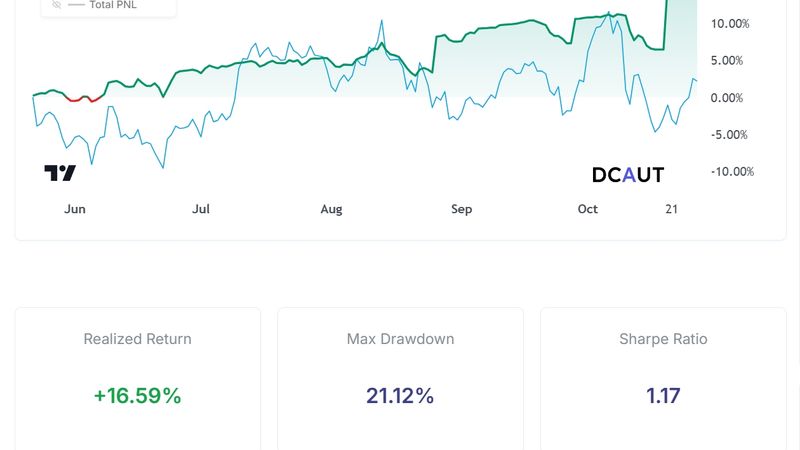
- BTC (≈5 months): realized return +16.59%, max drawdown 21.12%, Sharpe 1.17, annualized +42.55%, win rate 100%, 2,581 trades.
- BTC (≈6 months): +29.43% / 10.52% / 2.38 / +76.95% / 99.04% / 2,630.

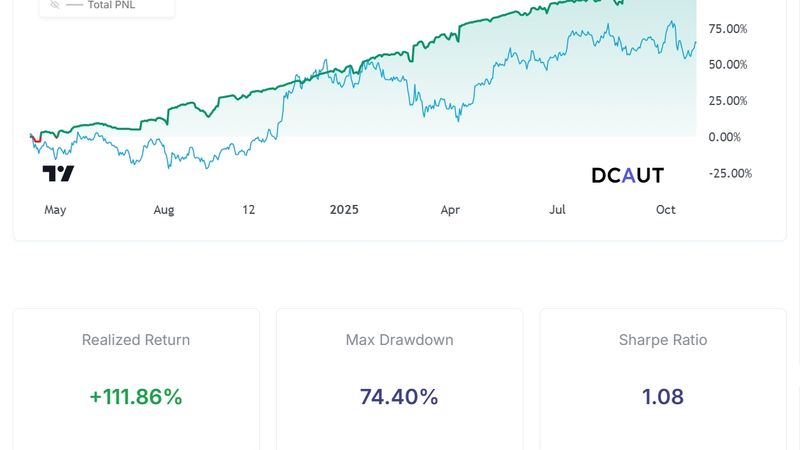
- BTC (≈18 months): +111.86% / 74.40% / 1.08 / +62.28% / 100% / 8,431.
- ETH (≈8 months): +28.67% / 9.70% / 1.43 / +44.06% / 99.09% / 3,364.
Cross-section: mean annualized return 56.46% (median 53.17%), median Sharpe 1.30, median max drawdown 15.82%. Total trades 17,006. The near-100% win rate should be interpreted with the entry/exit counting convention.

Visual Evidence & Observations
The green “realized return” curve generally sits above—and is smoother than—the light-blue buy-and-hold PnL. After one-way declines, the DCAUT equity curve crosses back above zero sooner and keeps climbing, reflecting cost reduction from “drawdown-tiered weighting + volatility adaptation.” On the longest horizon, the strategy shows a −74.40% max drawdown yet ends at +111.86% realized return, indicating deferred gains from “averaging-down,” while requiring stronger capital tolerance.
Mechanics (Why It Works)
- Volatility scaling: size each buy by ATR/median-ATR; larger volatility → more units per dollar, and vice versa, shaping a reflexive cost curve.
- Drawdown tiers: when the price drawdown vs. a local high deepens, trigger 1.2×/1.6× sizing to expand exposure in the “cost-advantage” zone.
- Realization & smoothing: many dispersed entries stabilize realized PnL; the curve is less sensitive to single-point noise; Sharpe >1 in most windows.
Risks & Boundaries
- Microstructure: high trade counts mean sensitivity to fees/slippage; a high win rate ≠ profit without considering payoff ratios and holding time.
- Capital tolerance: deep cyclical drawdowns imply that early-bear scaling can amplify paper volatility if risk budget is tight.
- Asset heterogeneity: set tier thresholds and vol factors by asset (BTC vs. ETH) rather than a one-size-fits-all rule.
Platform Implementation
We provide multi-style templates—Conservative (lower tiers, smaller multipliers), Balanced (baseline), Aggressive (larger multipliers, faster response)—and disclose: window win rate, drawdown distribution, equity-to-capital efficiency, and fee-sensitivity stress tests, plus reproducible backtest logs and scripts.
Conclusion
DCAUT’s edge is not price prediction but harvesting volatility: allocate more where volatility should be borne, align the cost curve with volatility, and convert randomness into average capital-efficiency gains. For users seeking long-term compounding with transparent numbers, it is a “steady-offense” curve worth adding to the mix.