
How Can You Make Money Faster with DCAUT Trading Bots? The Secrets Behind Their Live Results
How Can You Make Money Faster with DCAUT Trading Bots? The Secrets Behind Their Live Results
Published on: 11/5/2026

Have you ever wondered why your friend seems to be making a fortune trading BTC in the same market, while you keep losing money?
You are both looking at the same market, so why are your results so different? Maybe you bought too early and the price kept falling. Or you sold just before it went back up. Where you buy, when you sell, and how you manage your funds can all affect your results.
That is where a trading bot might come in handy. It trades according to a strategy you set, so you can spend less time watching charts and making decisions on the spot. But can you make money with DCAUT trading bots? And what should you look for when choosing one? Let’s look at three live performance records from the Bot Plaza.
If you are looking for ways to make money fast with crypto, learning about different crypto trading strategies and crypto trading tips is a good place to start.
1. When Copy Trading, Is a Bot with Higher Returns Always the Better Choice?
First, ask yourself this: if a bot had earned 160% but had also fallen nearly 40% from a high along the way, would you be comfortable with that?
Some people are willing to take on bigger swings for a chance at higher returns. Others prefer a smoother ride. Neither choice is automatically better. It comes down to how much you want to invest and how much volatility you can handle.
The DCAUT Bot Plaza offers different strategies, from single bots aiming for higher returns to portfolios that allocate funds across multiple assets. Let’s see how three of them performed in live trading.
2. What Is Your Investment Style? Which of These Three DCAUT Trading Bots Would You Choose?
The figures and screenshots below were captured on November 5, 2026, with the “All” period selected. Based on their returns and drawdowns in these records, we have grouped them as aggressive, balanced, and more conservative to help you consider your preferences. They trade different assets, use different allocations, and have different runtimes, so these labels refer only to the historical results shown.
First: WLD 8-Tier Aggressive (Aggressive: seeks high returns, with larger drawdowns and price swings)
WLD 8-Tier Aggressive had been running for 199 days. At the time of the screenshot, its cumulative return was 160.62% and its maximum drawdown was 39.21%. It still had open positions.
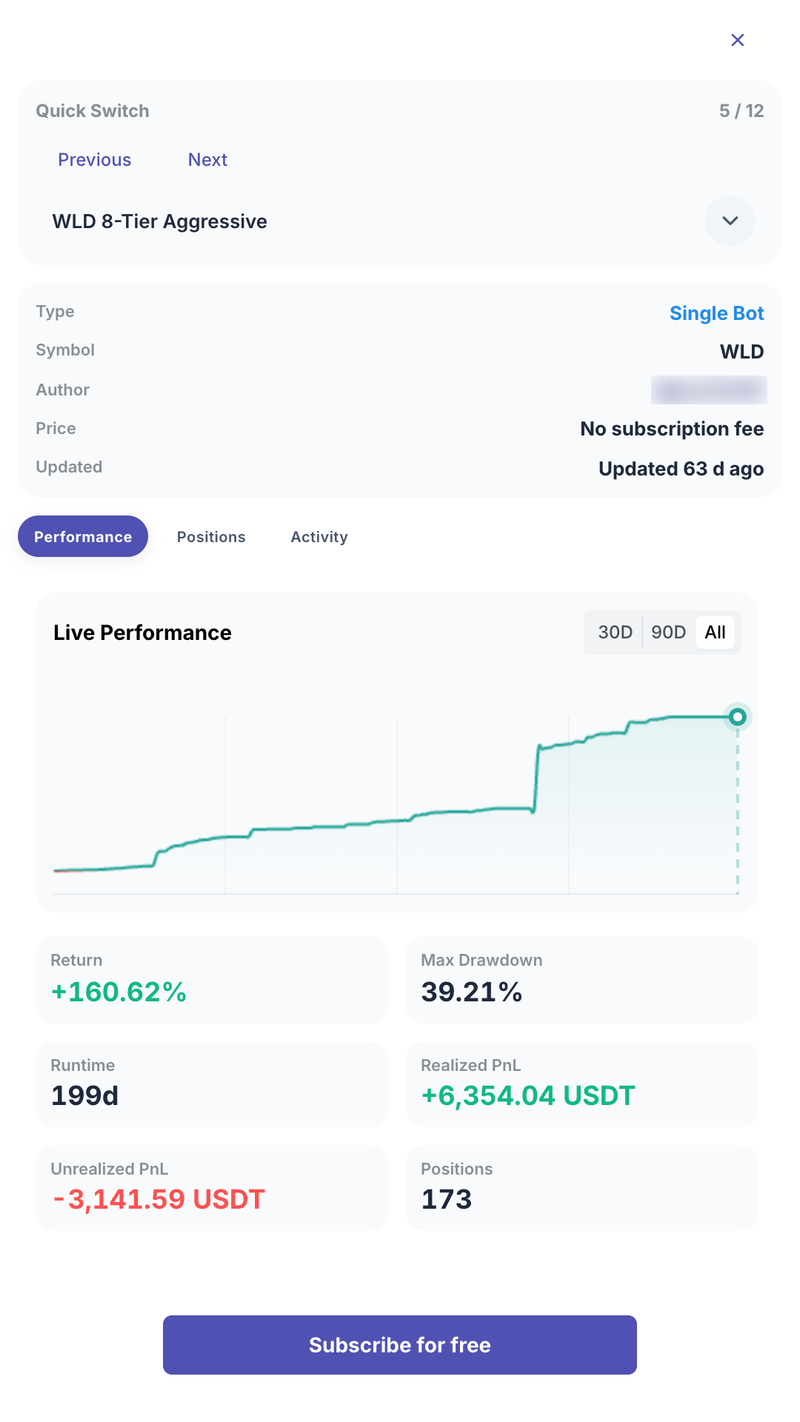
A 160.62% return looks impressive, but the 39.21% drawdown deserves a look too. It means the bot’s equity fell significantly from a previous high during its run.
For example, if equity reached 10,000 and then fell by 39.21%, it would be worth about 6,079. From there, it would need to rise roughly 64.5% to get back to the previous high. This is just an illustration of the percentages.
Second: CRCL Steady Trend & DCA Quant (Balanced: balances returns and volatility, with expected returns in the middle of the three)
CRCL Steady Trend & DCA Quant is a nine-tier strategy. At the time of the screenshot, it had run for 82 days, with a cumulative return of 14.15% and a maximum drawdown of 17.27%.
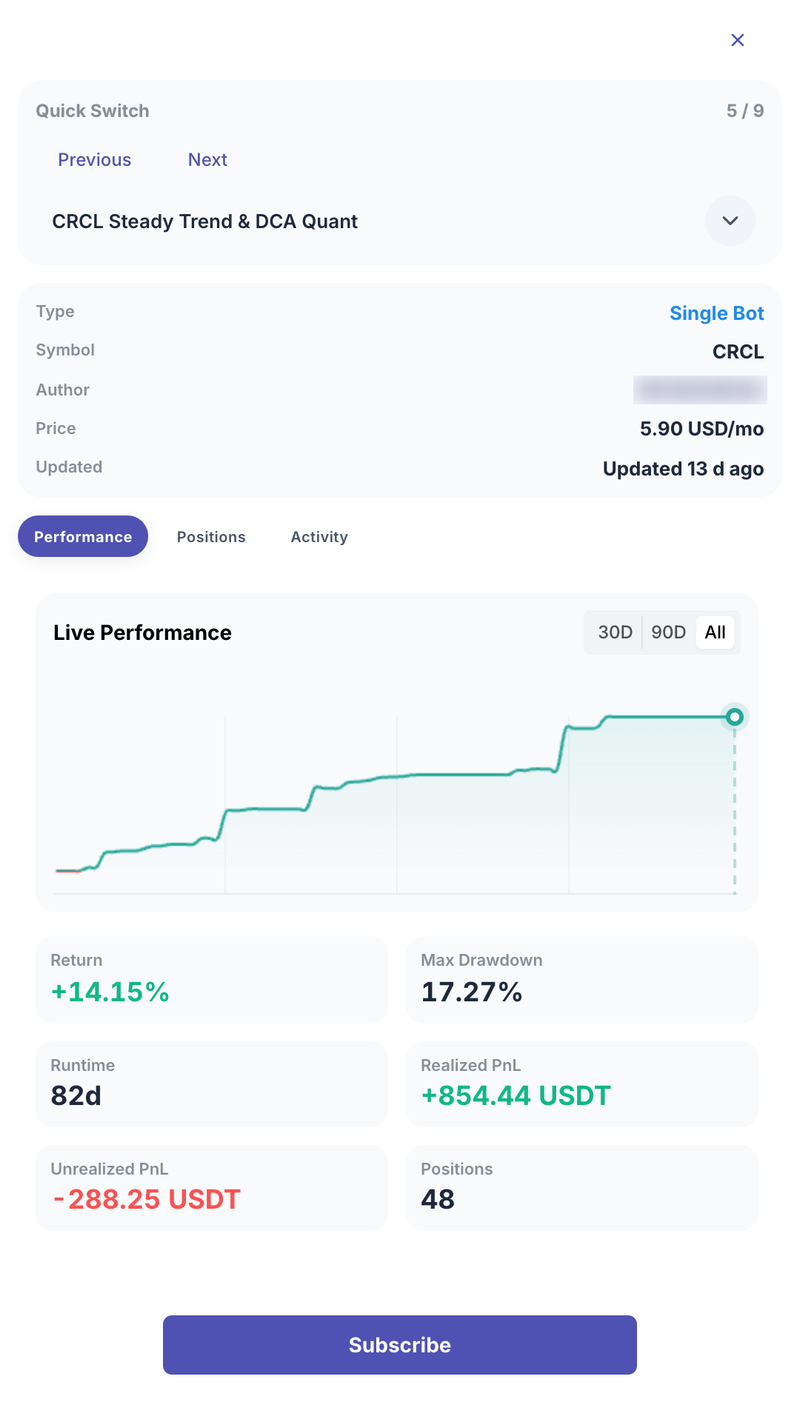
“Nine-tier” means the strategy allocates funds across several levels. Even though its name says “Steady,” it is worth looking at the actual results and deciding whether you are comfortable with that drawdown.
Third: US Stock Perps Smart DCA Combo (More conservative: focuses more on protecting capital and limiting drawdowns, with potentially lower expected returns)
US Stock Perps Smart DCA Combo is a nine-tier, multi-asset strategy trading four perpetual contract symbols: CL, COIN, MSTR, and TSLA. It had also run for 82 days, with a cumulative return of 10.21% and a maximum drawdown of 6.23% at the time of the screenshot.
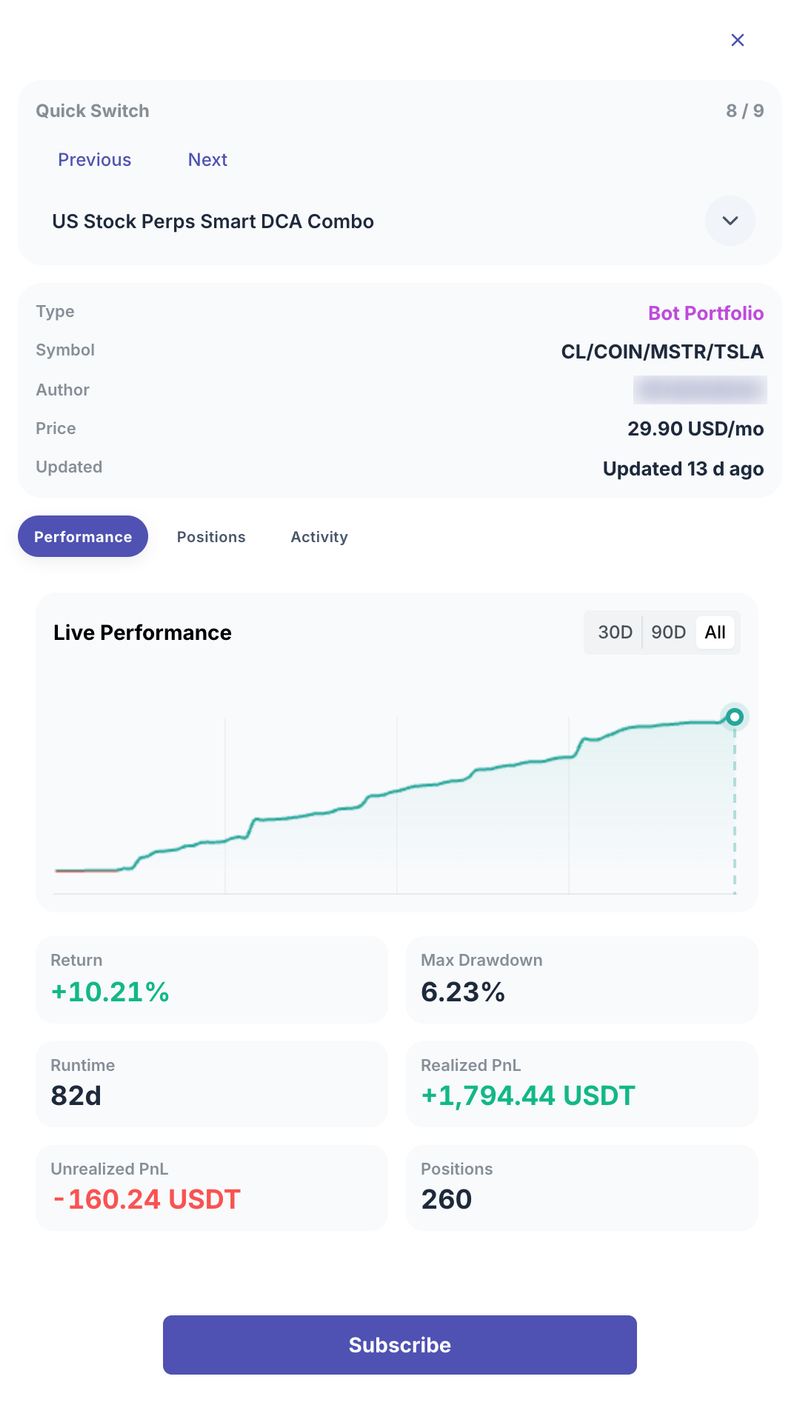
During this period, the portfolio had a lower drawdown than the CRCL single strategy above. The two traded different assets and used different configurations, though, so the difference cannot be attributed to diversification alone.
If you prefer smaller swings in your account, this kind of portfolio may be worth exploring. Consider whether it fits your own financial situation.
3. Don’t Want to Put All Your Funds in One Place? Here’s How This Portfolio Trades
Simply put, a nine-tier strategy divides the funds for a trading cycle across multiple levels. The DCA trading bot trades in stages according to its settings and may add to a position when the conditions are met. How much it adds at each level, and how much you need to set aside, depends on the configuration.
A multi-asset strategy trades different assets rather than putting all the funds into one. The portfolio above, for example, trades four perpetual contracts.
Once set up, the bot follows its rules without you having to watch the market and place every order manually. In unfavorable market conditions, however, positions and unrealized losses can grow. Using leverage also carries a risk of liquidation.
DCAUT’s operating target for the nine-tier multi-asset version is to aim for an annualized return of around 30% while trying to keep annual drawdown within 10%. This is a target. The portfolio shown above had run for only 82 days, so it does not represent a full year of results.
4. What to Look at When Choosing a Trading Bot
Start with drawdown. Return tells you how much a bot earned in the past; drawdown shows how far it fell from a high along the way. If that drop is close to 40%, ask yourself whether you could handle that kind of swing in your account.
A past maximum drawdown is not a limit on future losses. Before you start, look beyond the initial amount: check how much you may need for additional orders, as well as your leverage and exit settings.
Next, check the runtime. A bot that ran for 199 days and one that ran for 82 days have experienced different market conditions, so cumulative return alone does not tell the whole story. An annualized return may also be calculated from the time already recorded; it does not mean the bot has actually run for a year.
Don’t forget open positions. Some orders may have closed at a profit, while others remain open at an unrealized loss. Checking current positions and the funds they use gives you a more complete picture.
Finally, consider when you plan to start and how much you want to invest. Even with the same bot, different entry times, execution prices, and fees can lead to different results.
5. More Questions About Making Money with Trading Bots
Can You Make Money with DCAUT Trading Bots?
Yes. The DCAUT Bot Plaza has live records showing profits, including the three examples above. To understand DCA bot profit, look at returns, drawdown, runtime, and open positions together.
Why Can a Bot Keep Taking Profit While Its Equity Falls?
Closed orders may be profitable while open orders are losing money. When you look at both together, a bot can take profit regularly while its overall equity still falls.
Can the Nine-Tier Portfolio Guarantee a 30% Annualized Return and a Drawdown Below 10%?
These are DCAUT’s operating targets for this version, not guarantees of returns or drawdown. The portfolio above had run for 82 days; a full year of results requires a longer track record.
Will My Returns Match the Strategy Publisher’s After I Subscribe?
Not necessarily. Each bot runs in the user’s own exchange account. Start times, invested funds, execution prices, and fees can differ, so results can differ too.
If you want to try a bot, start by reviewing the “30D,” “90D,” and “All” periods in its Bot Plaza details. Then check the beginner’s guide to learn about configuration and backtesting. Look at both the returns and what happened along the way before deciding whether to observe the bot with a small amount you can afford to lose.