
Clever Strategies in Volatility: Why DCAUT's Enhanced DCA Can Build Positions Against the Trend
Clever Strategies in Volatility: Why DCAUT's Enhanced DCA Can Build Positions Against the Trend
Published on: 10/29/2025
In any mature financial market, one fact repeatedly validated by data is that the market is not in a clear one-way trend for the majority of the time (statistically over 70%), but rather in a consolidation phase with unclear direction and repeated oscillations.
However, the vast majority of market participants design their strategies, analysis tools, and psychological framework around the less than 30% of trending markets. This misalignment between “preparation” and “reality” leads to a widespread, disastrous consequence—Value Attrition.
This attrition manifests in three key areas:
- Strategy Failure Traps: Trend-following strategies receive many "false breakout" signals during consolidation, leading to frequent entries and stop-outs. Contrarian traders attempt to "catch the bottom," but in a consolidation phase, the bottom is a range, not a point, exposing positions too early and draining them in repeated volatility.
- Capital Efficiency Sinkhole: Capital is tied up ineffectively during prolonged sideways periods. Lacking clear profit expectations, investors either sit on the sidelines (missing the next trend) or hold positions blindly (suffering both time and opportunity costs).
- Decision Fatigue and Emotional Exhaustion: The consolidation phase is the most noise-heavy period. Erratic price movements challenge the confidence and patience of participants. Continuous small losses and profit retracements accumulate into Decision Fatigue, leading to emotional, irrational actions before the true trend emerges.
We call this phenomenon the "Consolidation Phase Meat Grinder". It doesn’t show up as a single large loss but rather as a high-frequency, low-amplitude attrition that systematically erodes the portfolio’s value.
Thus, the core issue for a professional investor to confront is: Can we, and how can we, transform these 70% of "ineffective time" into an efficient, low-risk "strategic building period"? This isn’t a question about "prediction" but about "system design".
To solve this dilemma, we must introduce a cognitive divide crucial in institutional investing, but often overlooked in individual practices: the difference between "event-driven" thinking and "process-driven" thinking.
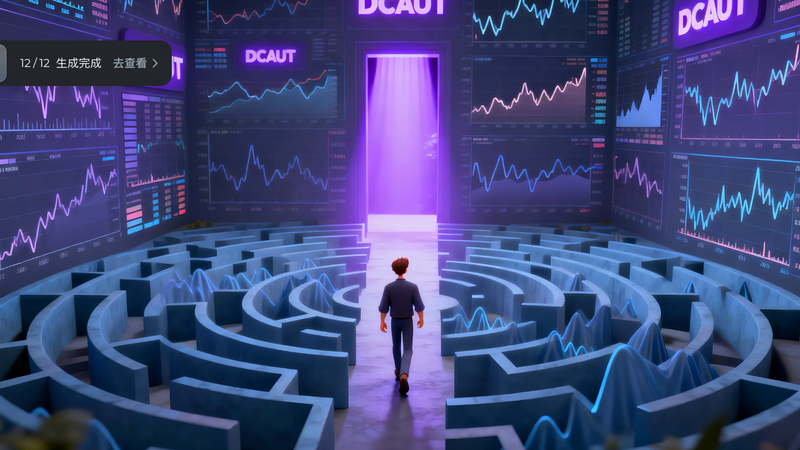
Event-driven thinking is a hunting-oriented, opportunistic model. Its core lies in waiting—waiting for a clear signal (e.g., earnings reports, policy shifts, technical breakthroughs) and attempting to make the "right move at the right time." This is human nature: our brains are designed to respond to strong, sudden external stimuli.
The Achilles' heel of this thinking lies in the consolidation phase. The consolidation phase is defined by a lack of decisive events. In such an environment, the "event-driven" brain becomes anxious, lost, and eventually caught by market noise.
On the other hand, Process-driven thinking is an engineering- and agricultural-like model. It doesn’t seek to "predict" a single event but to construct a system that generates a positive expected value regardless of how events unfold (within certain probability distributions). It acknowledges that the "perfect timing" is unpredictable, thus abandoning timing in favor of pricing and position management.
This leads to an intuitive counterpoint: The consolidation phase is, precisely, the most valuable application scenario for a process-driven strategy.
Why? Because the "high-frequency, disorderly fluctuations" and mean reversion properties of the consolidation phase provide the ideal raw material for systematically optimizing position costs. While others (event-driven traders) are anxious about the lack of direction, process-driven traders are quietly executing their accumulation process, leveraging the irrational price fluctuations caused by that lack of direction.
This shift from "waiting for opportunities" to "creating advantages" is not just a trading technique—it’s a philosophical distinction. It reflects how we view "uncertainty". Do we see "uncertainty" (volatility) as a risk to avoid, or as a resource full of Alpha to exploit?
The history of human society, to some extent, is a history of continuously inventing tools to use "systems" to hedge against the uncertainty of human nature. From the formulation of laws to industrial assembly lines, this has been the case. In the complex, information-overloaded game of contemporary finance, such "systematic" evolution has become the inevitable path for individuals to fight back against collective irrationality and high-frequency algorithms.
Based on this understanding, an ideal process-driven system must address the two major pain points of traditional strategies in the consolidation phase:
- Inefficient capital usage in traditional DCA.
- Emotional execution biases in subjective trading.
This is the core logic behind DCAUT's platform design. DCAUT is not a single tool; it is a dynamic trading engine deeply integrating institutional-level quantitative strategies with efficient trading experiences. Its core goal is to help investors systematically tame volatility during the consolidation phase.

The key weapon is the "Enhanced DCA" strategy.
First, we must deconstruct traditional DCA (Dollar-Cost Averaging). This "timed, fixed-amount" investment is a passive strategy. It may work in a long-term trend, but in the highly volatile consolidation phase of digital assets, its flaw is fatal: it passively allocates funds, investing the same amount whether the market is at a panic-driven low or an exuberant high. This results in the cost being "averaged" around the middle of the consolidation range, lacking a clear cost advantage. Moreover, it ignores the value of volatility, wasting the most precious resource in the consolidation phase—volatility.
DCAUT's Enhanced DCA is a fundamental innovation over traditional DCA. It shifts from passive averaging to active optimization, with its "enhancement" lying in its smart algorithmic perception.
It no longer relies on "time" but on "market state". The strategy engine monitors volatility and price deviation in real-time. During consolidation, it maintains "silent" or low-frequency accumulation.
The core of its "enhancement" lies in how it systematically handles extreme volatility. Unlike strategies that mechanically add positions based on a fixed price deviation (which can easily lead to liquidation in spike-driven markets), DCAUT’s logic is more intelligent. It first relies on smart signal sources, using indicators like ATR (Average True Range) to dynamically "sense" the market. When the system identifies an extreme state, it doesn't blindly add positions at high frequency; instead, it intelligently widens the next position increment based on the ATR calculation. This design greatly enhances both capital safety and efficiency, avoiding ammo depletion in liquidity traps.
This is the professional logic behind building positions against the trend: It doesn’t oppose the major market trend, but rather opposes the market’s short-term, ineffective emotions. It systematically executes the one thing professional investors dream of but human instincts struggle to achieve: "Be greedy when others are fearful."
As a result, when the consolidation phase ends, a trader relying on subjective judgment may find their cost still around the middle of the range or, in panic, having already cut their losses; meanwhile, the Enhanced DCA executor, through process-driven methods, has built a position with a cost line far below the market's center, giving them a highly competitive advantage.
Of course, DCAUT's professionalism lies in offering a "full-cycle" solution, not just a "single-scenario" tool.

During the consolidation phase (planting and cultivating), the Enhanced DCA strategy works to reverse emotions, establishing the core base position at panic-induced lows; meanwhile, the volatility strategies (such as grids and martingales) work to ride the waves, buying low and selling high with high frequency, creating continuous cash flow (Alpha) within the consolidation zone, further lowering position costs.
During the trend phase (harvesting), when the consolidation is broken and the trend is established, the dynamic tracking strategy is activated. It’s not a simple fixed take-profit, but rather dynamically tracks the trend, raising the take-profit line through algorithms, ensuring realized profits while capturing the full upward wave, greatly expanding the risk/reward ratio.
The core highlight of DCAUT lies in the seamless integration of strategy and experience. On the strategy side, it is not a cold formula but a dynamic engine that combines intelligent signal sources, allowing professional users to fine-tune parameters while providing easy-to-use presets for beginners. On the execution side, cross-exchange unified management and professional-grade risk control tools eliminate the friction and latency of multi-account operations, ensuring that strategy execution is not interrupted by emotions or operational mistakes. Finally, in terms of returns, automatic execution and real-time take-profit/take-loss free investors from emotional trading losses, allowing them to lock in profits more frequently.
Thus, we must recognize that the modern financial market’s competition has evolved from a "battle of viewpoints" to a "battle of systems". An individual decision-maker based on biological instincts and emotional biases is structurally disadvantaged when facing a quantitative system based on mathematics and discipline.
In the old "event-driven" paradigm, the consolidation phase is the "enemy", time is the "cost", and investors are "prisoners of time", passively suffering losses in anxious waiting. In the new "process-driven" paradigm, the consolidation phase is the "opportunity", and volatility is the "resource". The systematic investor becomes "time's ally", or more accurately, the "manager of market complexity".
Strategies like Enhanced DCA carry profound value, not only in offering a more ideal investment curve but also in representing a "cognitive liberation". It frees humans from the repetitive, high-pressure "execution" labor they are least suited for, allowing us to invest our valuable cognitive resources—our time, energy, and intellect—into areas we excel at: high-level strategy formation and big-picture analysis.
