
Guiding Tutorial of DCAUT
Guiding Tutorial of DCAUT
Published on: 12/26/2025
Part I: Core Strategies & Conceptual Encyclopedia
1. Martingale Strategy
The mathematical foundation of DCAUT’s position management. It lowers the average entry price by increasing capital allocation as the market moves against the position.
- Mathematical Logic: A specific percentage of price retracement allows the entire position to exit in profit.
- DCAUT Optimization: Unlike traditional Martingale, we use ATR Dynamic Spacing and Indicator Protection to prevent the risks of infinite scaling.
2. Grid Strategy
Engineered for sideways/oscillating markets. The system divides capital into equal segments across a price range, executing "buy low, sell high" at predefined gradients.
- Volatility Arbitrage: Captures micro-spreads within a range to achieve compounded growth.
3. Enhanced DCA (The Flagship Feature)
A premium strategy utilizing intelligent algorithms to sense market volatility. It solves the primary pain point of traditional DCA: exhausting capital too early during a vertical crash.
- Perception Logic: Integrates price action with technical indicators like RSI and Bollinger Bands.
- Delayed Entry: If the price drops but momentum remains bearish, the algorithm defers safety orders until a stabilization signal is detected.
- Advantage: Significantly reduces capital costs and achieves a much lower average position price than competitors.
4. ATR Take-Profit (Average True Range)
ATR measures market volatility.
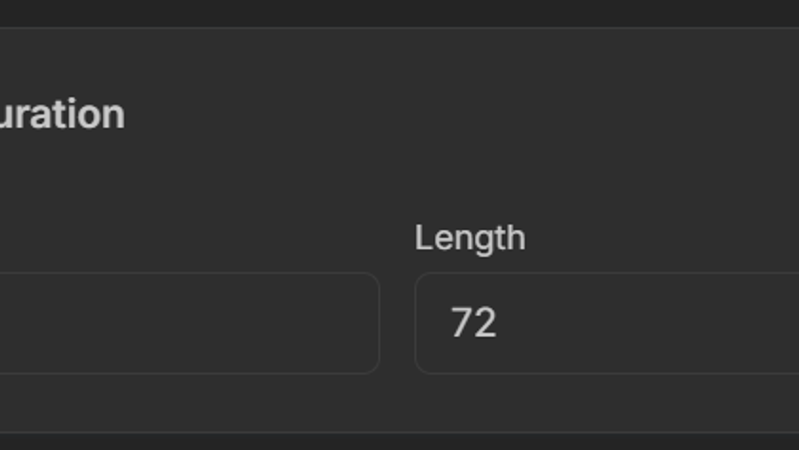
- Dynamic Adjustment: Instead of fixed percentages, ATR Take-Profit expands or contracts targets based on the market’s activity over the last $N$ periods.
- Scenario: Captures larger moves during high volatility and secures profits quickly during low volatility.
5. Trailing Take Profit
An advanced tool designed to maximize the Profit/Loss (P/L) ratio during strong trends.
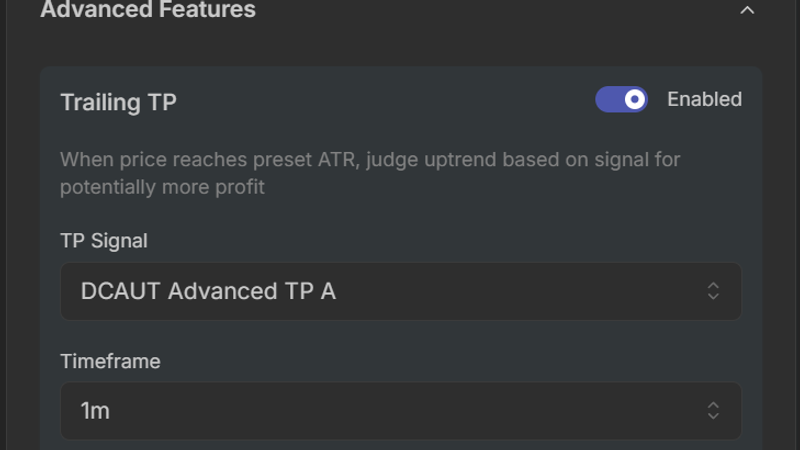
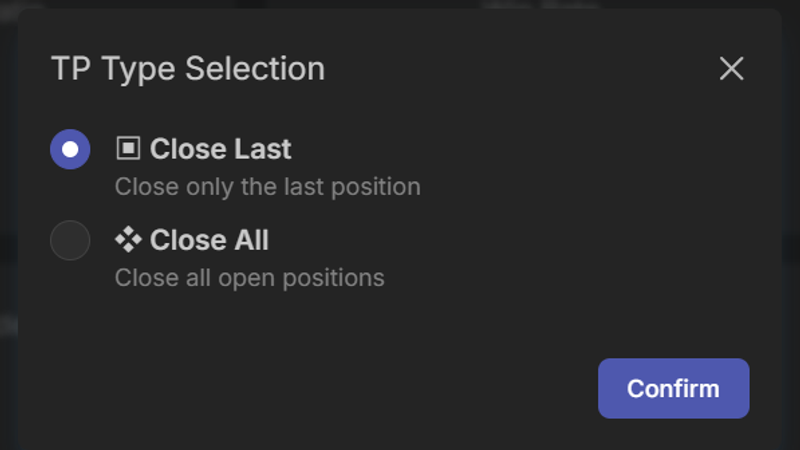
- Logic: Once the Take-Profit target is hit, the bot enters "Trailing Mode" instead of closing immediately.
- Profit Maximization: The exit line moves up with the price. The position only closes if the price retraces by a set percentage (e.g., 0.2%) from its peak.
6. Multi-Timeframe Signals
Core Principle: Set the signal timeframe based on your desired trading frequency.
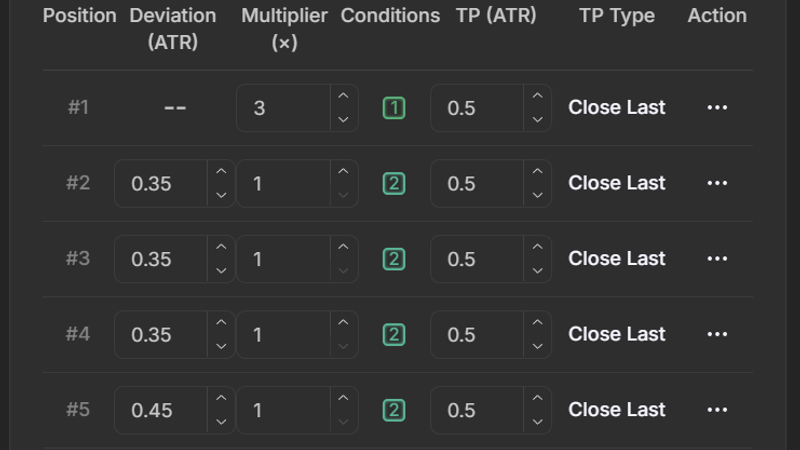
- Hybrid Execution: DCAUT allows mixing timeframes within a single strategy.
- Segmented Processing: Use short cycles (5m–15m) for initial orders to capture quick scalps, and long cycles (1h–2h) for deep safety orders.
- Risk Control: Large capital injections are only triggered when long-term signals confirm a market bottom.
Part II: Key Parameters & Configuration
Parameter Definition Impact Order Multiplier
The scale of subsequent safety orders.
A 1.5x multiplier means a 100U start followed by a 150U order. Speeds up break-even but increases margin demand.
Price Deviation
The distance between subsequent orders.
A 1.1x deviation widens the gap between orders (e.g., 1%, then 1.1%). Extends strategy longevity during deep crashes.
Risk Coefficient
A value derived from leverage, order count, and capital utilization.
Higher coefficients indicate a higher liquidation risk. Keep this within a safe range via backtesting.
Trend vs. Volatility
Strategy modes for specific market conditions.
Trend: Holds positions until the trend breaks. Volatility: Rapidly cycles through trades for liquidity.
Part III: Step-by-Step Operations
Step 1: Environment Setup
- Exchange Connection: Link your exchange (Binance/OKX) via API. Ensure "Enable Spot/Futures Trading" is checked and IP Whitelisting is configured.
- Mode Selection: * Novice: Use "Best Practices" on the left to apply expert-verified "Conservative" or "Aggressive" templates with one click.
- Advanced: Use the right-hand panel for full custom configuration.
Step 2: Logic Configuration
- Base Order: Define your initial entry size.
- Conditions (Signals): This is DCAUT’s core edge. Enable this to ensure safety orders trigger based on Technical Signals (e.g., RSI Oversold) rather than just price drops.
- Nesting: Assign different resolutions (15m, 1h, 4h) to different layers of your safety orders.
Step 3: Exit Strategy
- Set Target Profit: Input your desired ATR-based profit target.
- Enable Trailing: Turn on Trailing Take Profit to capture trend extensions.
Step 4: Full Data Backtesting (Crucial)
Never deploy without backtesting.
- Run the strategy against historical K-line data.
- Evaluation: Check the PnL Curve. If the Max Drawdown (MDD) exceeds your risk tolerance, increase your "Price Deviation" or "Safety Order" count.
Step 5: Live Deployment
- Compliance: Ensure KYC is complete and your membership is active.
- Self-Check: The system automatically verifies API status and subscription levels.
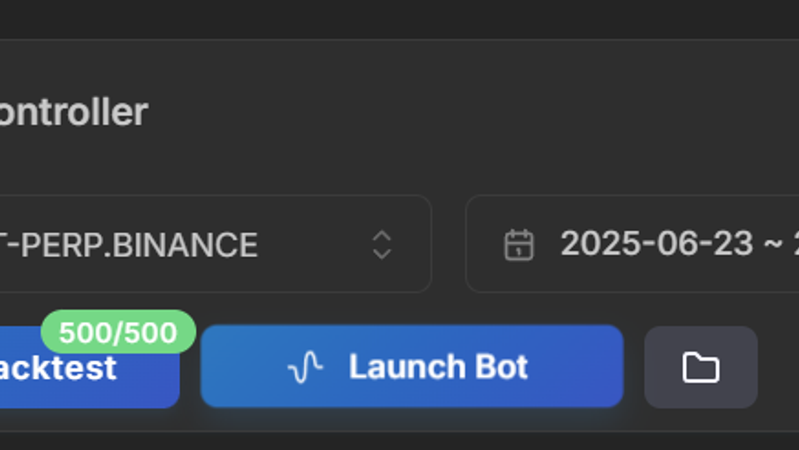
- Launch: Click "LAUNCH BOT" to transition from the test environment to live automated execution.
Part IV: Risk Management & Competitive Edge
Why Choose DCAUT?
- Superior Capital Efficiency: The Enhanced DCA algorithm prevents capital from being wasted during the middle of a crash, concentrating it at the point of reversal.
- Lower Cost Basis: Intelligent safety orders keep your average price closer to the market price, allowing you to exit "underwater" positions up to 30% faster.
- Institutional UX: Complex quantitative logic is distilled into a clean, intuitive dashboard.
- Regulated & Compliant: DCAUT provides a secure, compliant foundation for both capital safety and strategy execution.
Technical Disclaimer:
While quantitative trading models reduce risk, they cannot eliminate systematic market risk. Users should fully understand all parameters, conduct thorough backtests, and trade according to their financial capacity.